

Rekha Gati, as the name suggests (‘Rekha’ – line and ‘Gati’ – motion) in the context of exercise, is walking in a straight line. It is more than exercise as it helps us in developing discipline, concentration and balance. This exercise seems easy and casual but has wonderful and extraordinary achievements associated out of the mastery of this exercise. This exercise must be taught to the children so that their foundation of concentration can be strengthened. Although there are other methods of increasing concentration and reduce distractions, as the Harvard Medical School suggests, but this is the only exercise that has simultaneously other benefit of improving the gait of the body and achieving the balance, which no other exercise has.
Table of Contents
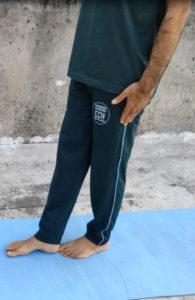
Starting Position of Rekha Gati (Walking in a Straight line)
Stand erect keeping your arms straight while keeping your palms attached with the thighs. Feet should remain grounded on the floor.

Exercise/ Technique of Rekha Gati
- Keeping the left foot on the ground, lift and place your right foot in front of the left foot so that the right heel touches the toes of the left foot. Keep neck straight and look forward and straight and eyes should not look at the feet.

- Similarly, while keeping the right foot fixed, lift and place your left foot in front of the right foot so that the left heel touches the toes of the right foot.
- Walk many steps, say 15-20, in this way ahead with the heel of one foot touching the toes of the other in such a way that the entire distance is covered in a straight line.
- Then walk same number of steps backward in the same manner as above and in a straight line. However, Swami Dhirendra Brahmachari, author of Sukhsama Vyayama, suggested to walk 50 steps. If you have less space at your home or gym or roof or terrace, you can walk only 15-20 steps forward and backward.

Precautions of Rekha Gati
As usual, we should always be more aware of the precautions of any exercise than its benefits. So, in case of Rekha Gati, any person can do it easily. My experience generally warns those who have sciatica pain. They may have some difficulty while picking up and placing the foot as desired in the steps of Rekha-Gati.
To know what to do and what not to do while doing asanas and pranayama, you must learn about the basic common sense of asanas and pranayama.
Benefits of Rekha Gati
Swami Dhirendra Brahmachari, author of Sukshama Vyayama has mentioned the following benefits of Rekha Gati, I have explained these benefits alongwith.
- It increases the power of concentration and improves the balance of the body. The linear movement improves concentration as well as balance in the functioning of the various muscle-groups concerned primarily with posture.
- By mastering this exercise, our neuro-muscular coordination is improved. Because of this mastery of this discipline, the concentration is developed beyond. This exercise is must for students who are preparing for competitive exams (Medical, Engineering & Management) as they require special concentration. I have myself observed the effect of this exercise over my students who have gained a lot from this exercise.
- This exercise is also recommended to the IT Professionals who are in the coding and programming fields and therefore require good sort of concentration.
- This exercise improves the Body Gait and therefore, is boon to our army or the police force*.
- Proper Gait means that you place your feet parallel on the ground so that you walk straightway. But such trend is missing in many people. Their feet ground habitually in opposite directions while waking. They usually need gait training which can help improve ability to stand and walk. Generally, this may be correlated to an illness or injury in the past. Moreover, their knees touch each other during walking. Some people feel embarrassed by their own erratic walking manner.There are walking abnormalities that can be classified as follows:
- Propulsive gait: A slouched, rigid posture characterizes this gait. A person with this condition walks with their head and neck thrust forward.
- Scissors gait: A person with this gait walks with their legs bent slightly inward. As they walk, their knees and thighs may cross or hit each other in a scissor-like movement.
- Spastic gait: A person with spastic gait drags their feet while walking. They may also appear to walk very stiffly.
- Steppage gait: A person with this condition walks with their toes pointing downward, causing their toes to scrape the ground while walking.
- Waddling gait: A person with this gait waddles from side to side when walking.
- Luckily, the abnormal gait can be improved by the regular practice of Rekha Gati every day, as this exercise improves neuro-muscular coordination and balance.
- Proper Gait means that you place your feet parallel on the ground so that you walk straightway. But such trend is missing in many people. Their feet ground habitually in opposite directions while waking. They usually need gait training which can help improve ability to stand and walk. Generally, this may be correlated to an illness or injury in the past. Moreover, their knees touch each other during walking. Some people feel embarrassed by their own erratic walking manner.There are walking abnormalities that can be classified as follows:
- Regular practice of this exercise makes it possible to walk on a thin rope. Such is the power of this exercise. This is of special benefit to acrobats. DISCLAIMER: But never try this without guidance of acrobat or gymnast professionals.
In nutshell, Rekha Gati improves the overall Body Language.
RELATED: SARVANGAPUSHTI – Whole Body Development
* In fact, all the five exercises in the sthula vyayama are very helpful to the police or armed force according to the nature of their duties. The Sthula Vyayama exercises help one to gain an over all control and development of the bigger muscular groups. Alongwith, these exercises help
- in the development of concentration,
- rhythmic activity of different muscle groups
- exercising as many as or all musculo-articular groups
- Deep Respiration (which helps in build up of lung capacity)
RELATED: UGC Net Yoga – Best Multiple Practice Tests & Quizzes
Learn Sthula Vyayama - Rekha Gati
Learn Sukshama Vyayama and Sthula Vyayama for comprehensive health.
Course Provider: Person
Course Provider Name: Gulshan Kumar, NDDY, BPT, M.Sc. Yoga, PGDIploma (Yoga Therapy), M.Sc. (Spiritual Health & Counselling), QCI Yoga Teacher Level 2, UGC NET (YOGA) Qualified
Course Provider URL: https://forms.gle/bGTmPLY51aNpt4B88