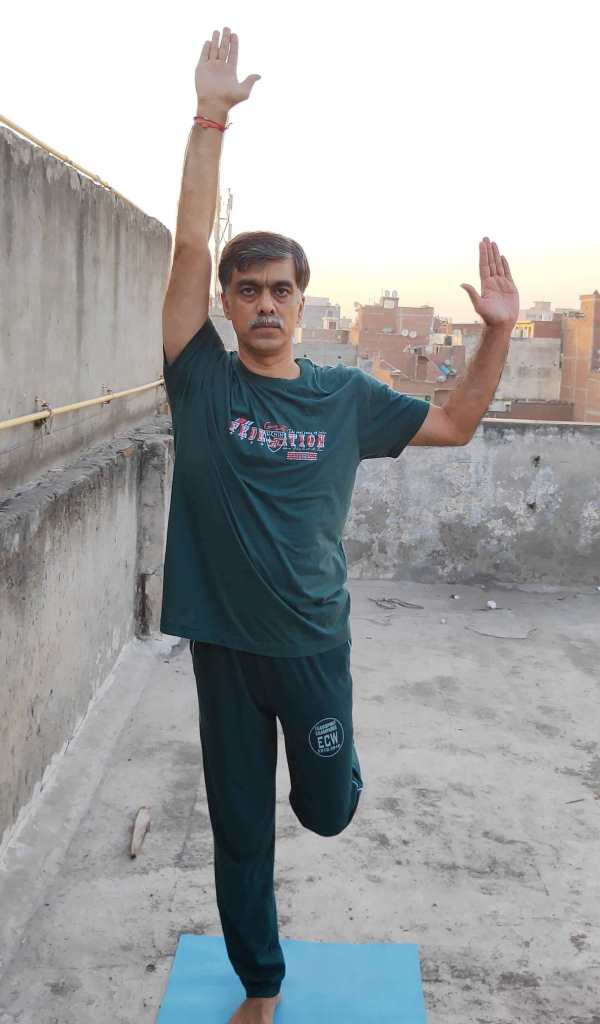
The phrase Urdhva Gati means (Urdhva – Upward Gati – motion) Upward Movement has been given to this exercise, as this exercise involves the upward movements of the arms synchronising with the breath and articulation of the lower limbs. You will find that all the exercises of Sthula Vyayama are intended to improve neuromuscular coordination and concentration in addition to muscular development of the limbs. This is the biggest advantage of the sthula vyayama. I could not find the same feature in any other category of exercises.
Table of Contents
Starting Position of Urdhva Gati (Upward Movement)
With feet one foot apart, hold one arm bent at the elbow at an angle of 90 degrees while the other is stretched straight upwards. The palms of both the hands must remain open, facing outward with the fingers together.
Exercise/ Technique of Urdhva Gati (Upward Movement)
- Bend your left knee and stretch your right arm upward (Position No.1)

Urdhva Gati Position 1 Inhale - Repeat this process with the right foot and left arm raised.(Position No.2)
Urdhva Gati Position 2 Exhale - Breathe in and out to synchronise with the movement of your limbs.
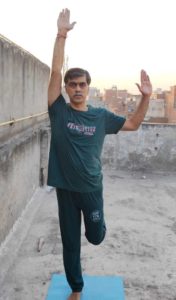
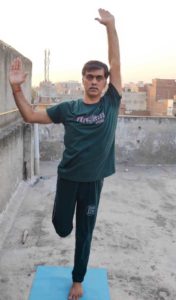
Remember that both limbs of the same side are either bent at 90 degrees or in a straight line. Like if your right arm is bent at 90 degree, your right knee will also be bent at 90 degree and the other side arm and leg will remain straight. This will be alternated while synchronising your breathing. You can also alternate the breathing pattern with the movements of your arms and legs. Like Hrid-Gati, keep on alternating the positions of the limbs with breathing patterns without holding.
In the beginning, you can practice 25 times and slowly increase the number of rounds for every week, as per your capacity.
RELATED: Achieve your muscular body with HRD-GATI (yogic jogging) – Engine Daud
Follow up this exercise with complete relaxation and deep breathing to avoid any muscular fatigue. We should never ignore warm up prior to the workout and relaxation post workout. There are three types of relaxation, i.e. Instant Relaxation Technique, Quick Relaxation Technique and Deep Relaxation Technique. You can choose as per your convenience of your time availability.
Precautions of Urdhva Gati (Upward Movement)
As usual, we should always be more aware of the precautions of any exercise than its benefits. So, in case of Urdhva Gati, any person can do it easily.
- My experience generally warns those who may have frozen shoulder or knee pain. They may have some difficulty while articulating the shoulders /knees as desired in the steps above.
- If you have high blood pressure or cardiac issues, you must do it very slowly and that too in consultation with your physician.
- Arthritis can limit your mobility in this exercise. So, do it very slowly.
To know what to do and what not to do while doing asanas and pranayama, you must learn about the basic common sense of asanas and pranayama.
RELATED: SARVANGAPUSHTI – Whole Body Development
Benefits of Urdhva Gati (Upward Movement)
- This exercise is good for the limbs and for circulation.
- Neuromuscular coordination is improved and balance is improved.
- Lungs capacity is improved. We get partial benefits of Bhastrika Pranayama with this exercise.
- Pectoral Muscles i.e. Shoulder muscles & thigh muscles, i.e. hamstring muscles and calf muscles, i.e. gastrocnemius are developed.
Urdhva Gati -Achieve 3 Advantages Balance| Circulation|Limbs
Urdhva Gati is similar to Hrid Gati but more focused on neuromuscular coordination and balance, in addition to development of the muscles of the limbs. It improves the circulation.
Course Provider: Person
Course Provider Name: Gulshan Kumar, NDDY, BPT, M.Sc. Yoga, PGDIploma (Yoga Therapy), M.Sc. (Spiritual Health & Counselling), QCI Yoga Teacher Level 2, UGC NET (YOGA) Qualified
Course Provider URL: https://forms.gle/bGTmPLY51aNpt4B88