Hi Tommie,
Let’s first discuss in layman's language about what hernia and where it generally occurs in the body.
Hernia literally means protrusion, in the context of our anatomy, it is protrusion of an organ or a part of an organ - through the wall of the cavity in which it is normally contained. In the context of your question, it is abdominal cavity in which abdominal organs are contained.
Protrusion can happen anywhere through the abdominal wall. So, based on the location, the following are the main types of hernia.
(i) When it happens through the oesophageal hiatus of the diaphragm. The two common types are sliding hernia and para-oesophageal hernia. In the former hernia, the stomach slightly slides into the diaphragm and in the former one, part of the stomach protrudes into the diaphragm cavity. Similarly, when the lower end of the oesophagus and the adjacent part of the stomach herniate into the thorax, then it is called Gastro-oesophageal hernia.
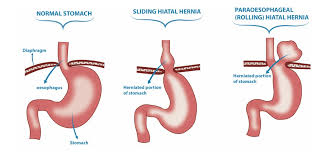
(ii) The second type is Inguinal hernia. Why it is called inguinal because here the protrusion of part of the intestine is into inguinal canal. Similarly, when the inguinal hernia descended into the scrotum, it is called scrotal hernia.
(iii) When there is protrusion of the bowel or omentum at the navel, it is called umbilical hernia.
These hernia are generally protruded as loops and when there is tightly constricted and has become or likely to become sphacelated.
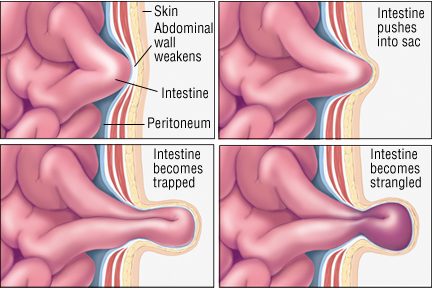
If you look at the picture, you will find that during normal condition, the organ (intestine) is contained in its cavity and does not protrude.
But in second picture , there is simple hernia, a condition which would become normal on lying down or on being slightly manipulated by hand gently
Third and fourth picture are when the part of the intestine is strangulated.
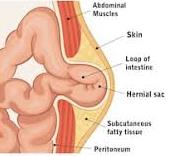
The common cause for hernia is progressive weakness of the tissues of the abdominal cavity. This weakness is because of adoption of unhygienic living habits. What happens after that is the weakened abdominal tissues gradually stretches at places wherein the nearby organ presses over them and get into them, which appear like swelling. If the unhygienic living habits continue, then the stretching continues beyond a particular point, when these tissues might get ruptured and the organ may escape through the rupture into the adjoining cavity like scrotal hernia.
As discussed earlier, it is because of modern society lifestyle - absence of proper exercise, adoption of improper posture and wrong dietary habits, obesity, the most common hernia developed by men is inguinal hernia (protrusion through the inguinal canal) whereas femoral hernia (protrusion through the femoral canal) is developed by women. Among the causes, constipation should never be ignored as the pressure caused by the retained faecal matter (retained over a number of days and weeks or even longer) in the large intestine distends it and this may also cause hernia as the distended colon interferes with the nerve and blood supply in the lower abdomen and weakens the abdominal and pelvic muscles. So, one should be cautious to prevent constipation further.
However, your question may be an indication of the presence of hiatus hernia. If such is the case, one should follow dietetic programme, water cure methods like cooling abdominal wet pack for improvement to an extent and may be, the stomach may not bulge anymore through the diaphragm as it used to do before natural treatment or allopathic treatment as recommended by physician/ doctors.
As far as your question in regard to the bandhas is concerned, you should take care to observe if the bulging out of herniation is significant, to be on the safeside, you should not perform jalandhara and/or uddiyana bandha. Whereas you may practice moolabandha if it does not cause any influence/ force on the protrusion. Generally, all sorts of asanas are restricted in hernia patients not defining the location of herniation. I would suggest you to first get the complete treatment first and then under the guidance of some qualified yoga therapist, you should follow the yogic regimen.
I hope that the above answer satisfies your question/ doubt. I would be happy to receive your reply/feedback on this answer if any doubt exists further.
Images Source:
stutterstock.com
2minutemedicine.com
herniagallbladderwa.com.au